
Is Venice A City Floating on a Submerged Forest?
This is a very interesting fact about the origin of a city that still stands in its full magnificence thousands years on.
Since 421 AD, Venice has stood on millions of tree trunks stuck into the clay bottom of the lagoon.
Not steel or concrete, but mostly alder, with a few oaks, support the entire city.
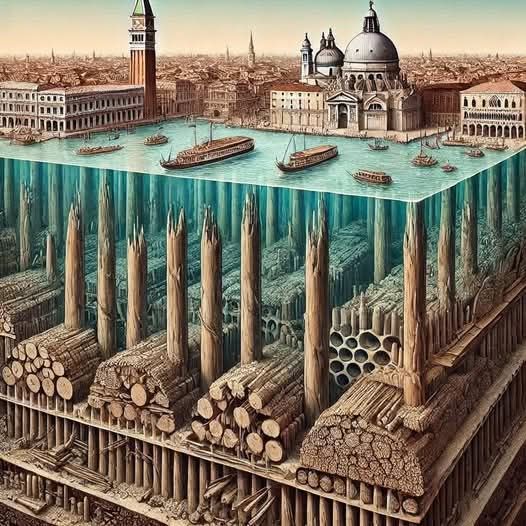
In the salt water, these wooden pillars have petrified over time, becoming as hard as stone. St. Mark’s Campanile alone stands on 100,000 piles, while the majestic Basilica della Salute required over a million trunks. The ancient builders beat these trees into the seabed, creating a veritable submerged forest.
This unique structure extends up to three meters deep, with piles spaced just half a meter apart. At 1.6 meters below the waterline, this extraordinary feat of medieval engineering continues, after 1,500 years, to support one of the most fascinating cities in the world.
It’s a known fact that Venice has been gradually subsiding (sinking) for centuries. This is due to a combination of factors, including the natural settling of the lagoon’s sediment; historical groundwater extraction, which compacted the soil and to some extend, tectonic plate movement.
Compounding the subsidence is the rising sea level due to climate change. This makes the city increasingly vulnerable to flooding. Currently Venice experiences frequent “acqua alta” (high water) events, where high tides flood the city. These events are becoming more frequent and severe due to sea level rise.
To combat the flooding, Italy has implemented the MOSE (Modulo Sperimentale Elettromeccanico) project. This is a system of movable floodgates that can be raised to protect the city during high tides. This keeps the city from “sinking” and thus the effects of the high tides, that are exasperated by the slow sinking, are being mitigated.
 Oggs' Earth
Leave a comment